Wednesday, March 29, 2006

Think:Lab

Christian Long is another lifestylist. In his ongoing thinking about the future of learning and the design of schools, he's also digging into big questions about what constitutes a meaningful life and how learning prepares us to do good work. His writing has been so intense and prolific lately that's it's hard to keep up. From Will That "What I'm Gonna Be After Graduation" Job Even Exist When You Graduate?:
"All well and good to ramp up on math classes and get the kids to 'pass the test.' But, and maybe I'm 'off' a bit on this, if we don't spend a fair amount of time helping the same kids/students with some visioning exercises as to what they might 'do' with their lives once they graduate, it will seem to be a lot of skills without an arrow attached. Or even a rubber band to at least help them adapt and rebound as the future changes much of the game of work."
He's not off at all. I consider this a major failing of the school system right now. Envisioning, finding and creating a meaningful life path is a skill (or set of skills) that does not get taught in schools, and most parents are clueless about it except to scare their kids into college as if that was the automatic guarantee for great jobs and passionate work. So if schools and parents aren't going to do it, who is? From Vocation Vacations for Test-Driving a New Career:
"Okay, if I didn't already have my dream job, I'd be giving serious thought to this opportunity created by a corporate dropout named Brian Kurth who figured out that there may be a way to help a few other good souls wrestling with a career change try on their fantasy career for size."
And one more that digs into some of the skills kids will need:
Forget College. But Can You Interview? --
"Because at the end of the day, the future belongs to those who can tell a great story, demonstrate passionate interest combined with the ability to problem solve and 'figure it out' on the fly, and who have the audacious ability to care enough to 'go after it.' Teachers and parents: what have you done lately to help your 'little one' be in this position?"

Sunday, March 19, 2006

New Moms Exhausted

From the Business of Life, bouncing off a new study -- New Moms Exhausted:
"Or to learn that 76 percent of working mothers return to work within a year after the birth of their child. Forty-one percent of working mothers are back within three months, and nearly one in six is back within the first month after delivery."
It boggles the mind to imagine the societal (and lifestyle/family) implications of half of the kids in an entire generation being raised by institutions from the time they're three months old. She also had an interesting recent post about contempt for parenthood:
"The painful paradox is that while women have liberated themselves from being defined by their biology - the fate of the girl in many African and Asian societies who is not truly a woman until she has given birth - mothers have ended up relegated to the status of constant abject failure in a culture driven by consumerism and workaholism."

Tuesday, March 14, 2006

What's Next for Vocational Education?

What's next for voc ed? covers the marginalization of vocational education programs in Michigan in favour of college-prep academic programs. Meanwhile, we're seeing demand (and wages) rising in the skilled trades. It just doesn't make sense.

Thanks to think:lab, where Christian posts:
"Just when 'vocational' programs have finally come out of the dark ages and gained a little bit of respect in the new guise of CATE (Career and Technology Education) Centers, the following article comes out and makes you wonder if the support will remain. Not because they don't work...sadly."

Tuesday, March 07, 2006

Authentic Happiness

I can't remember now how I came across
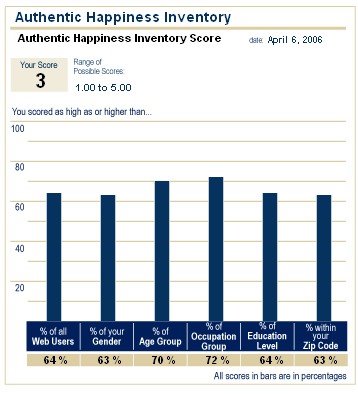
Authentic Happiness: Using the new Positive Psychology from the University of Pennsylvania, but it's really fascinating stuff. They've got a bunch of questionnaires to measure your happiness, including overall happiness, optimism, gratitude, grit, close relationships, meaning, strengths, and many others. Once you register, you can see all of your results in one place, along with analysis of your approach to life.

Monday, March 06, 2006

Built-in Altruism?

Phatgnat linked to this BBC article: Altruism 'in-built' in humans. It seems pretty light on facts, but I find this train of thought fascinating. One of the problems I've found with the lifestylism concept is that values are so relative. If you're aligning your lifestyle with ugly values, the resulting lifestyle will be ugly. But what if we're inherently good?

Thursday, March 02, 2006

Working the Network for Web Work

I've never met Will Pate, but I've been checking in on his blog since he was out in the Maritimes. This morning I swung by there and found a fascinating post: Web Marketing Prodigy and Sales Rainmaker Seeks Awesome Job.

I guess I've seen people use their blogs to find work and initiate transitions before, but it just hit me again how the web changes turns these things upside down. Instead of the solitary job-seeker firing out resumes to oblivious HR departments, or even working the phones to see if anyone in their network can help hook them up, they can put the word out online with posts, resumes, profiles, work samples or whatever (and still work the traditional back channels). Will wants to stay in Vancouver, but lists some other places he'd move to for the right opportunity -- the potential web of connections and interested groups could be pretty big.

Then the strength of weak ties can really work some magic, when the distributed network starts stumbling across (and sending links around about) someone looking for work and seeing their interests, skills, voice and network displayed in one place with a great deal of depth. A powerful model, especially when an employer can use the medium to find and communicate with others in the job seeker's network. Within a few clicks, I could find the blogs (and contact information) of pretty much everyone Will has worked with in the past year -- if I'm looking to hire a web marketing and sales specialist, that information is invaluable.

The other thing I find interesting about this phenomenon is seeing these young, smart webheads leaving great jobs in web companies on the rise -- it seems to be happening all the time. Will pointed to another one using his blog in the same way. Job turnover isn't surprising, and the whole free-agent ethos isn't new, but something feels right about working at a place long enough (18 months? Two years?) to learn some new skills and help an organization with a specific goal, and then move on to new challenges before the old ones get stale.

Update: Just in case anyone wonders whether Will's job-hunting approach worked, he got interest from 30 companies and picked one.

Wednesday, March 01, 2006

Flow and Happiness

Csikszentmihalyi's secrets of happiness:
"Over the years, I came up with the expression 'flow': a term to describe the common denominator among those people who deemed themselves happy. The most obvious component of happiness, I found out, is intense concentration, which is the main reason that activities such as music, art, literature, sports and other forms of leisure have survived. The essential ingredient for concentration — whether it happens when reading a poem or building a sand castle — is that it involves a challenge that matches one’s ability. The only solution to achieve enduring happiness, therefore, is to keep finding new opportunities to refine one’s skills: do one’s job better or faster, or expand the tasks that comprise it; find a new set of challenges more appropriate to your stage of life."
Thanks to Chris Corrigan for the pointer to this article. I've been a fan of flow for years -- it's one of those ideas that pops up over and over in unexpected contexts.

Tuesday, February 28, 2006

Planner

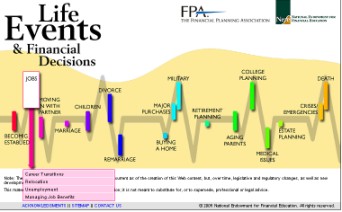
The Business of Life blog pointed to this Life Events & Financial Decisions Planner. It's basically just a way of browsing their articles, but the life-wide structure is interesting.

Friday, February 24, 2006

Dilbert Wisdom

Today's Dilbert just nails the lifestylism concept. How should I take this when my boss sends it to me in an e-mail?

Detroit's Wild Kingdom

Apparently there are inner-city areas in Detroit that are being reclaimed by nature, because homes and entire neighbourhoods have been abandoned for years. As they get torn down or gutted (but not replaced), trees take over. Neglected and empty skyscrapers and buildings downtown have trees growing on roofs and pigeons taking over inside. The images are truly striking:Meanwhile, the suburbs and exurbs keep growing and sprawling out away from the city -- and all the people moving/living out there have to drive to get anywhere. There's something so Mad Max about this story, but the apocalypse seems to be happening so slowly.

Thursday, February 23, 2006

Man on a Mission

I'd say that Aiden Enns sounds like a lifestylist (in a good way). The founder of the Buy Nothing Christmas and past managing editor of Adbusters writes about his efforts to align his values with his lifestyle:
"To address a chronic self-dissatisfaction with my lack of radicalness, I've tried to adjust a few things. Like expectations for retirement, for example. At this rate we'll have a nice house and a long resume filled with non-profit entries. My retirement plan includes basic gardening skills, geothermal heat, solar electricity, cylcle-powered clothes washer, manual coffee grinder and, if we're lucky, rental income from housemates. And I promise never to get sick, and I'll be healthy and able-bodied till the day I die. Uh, I guess there's a couple holes in my dream package.

But this, according to my gut, is still better than getting a day job, fueling the big-bank business and supporting the free trade, crazy-market game. Why, even the very category of life called 'retirement' is problematic - it's like we work most of our life (i.e., slave away at jobs that keeps us from family, home and personal passions) and then finally get to rest. I'd rather live most of my life (i.e., pursue my passions and 'hunt and gather' food along the way) and then when I'm old, I'll live some more (yes, my inner rationalist is nervous at the thought)."
I love the wonderful honesty and sense of searching here, and the strong undercurrent of activism that brings me back to the anarchist roots of the term I used to dub this whole experiment.

Sunday, February 19, 2006

Mapping Personality Visibility

A fascinating and simple way to figure out (and represent) how you're perceived by others: Interactive Johari Window.

Saturday, February 18, 2006

Are We Happy Yet?

The Business of Life linked to this fantastic study on happiness. It looks like in the U.S., your best chance to be very happy is to be married, religious, Republican, rich, white, and living somewhere warm. The analysis of the study results is breezy and fun, with lots of interesting observations:
"Keep in mind, however, that even taking into account all these factors, we don't actually improve by very much our ability to predict which specific individual is likely to be very happy. If we knew who'd been fired last week, or who's a glass-is-always-half-full kind of person, we'd probably do a lot better."
Shamash was also thinking happy thoughts this week:
"Though I can appreciate his sort of "ethical happiness", I simply love those few times during the week where I just have to smile at how big and beautiful this world is. What lovely creatures walk this earth, and how honored I am to have been able to meet and learn to know a few of them."

Thursday, February 16, 2006

Following Your Gut

The Business of Life has a great post about the differences between how people make difficult life decisions and simpler decisions. She quotes from a study summary (the report itself is behind a subscription wall):
"However, as the decisions become complex (more expensive items with many characteristics, such as cars), better decisions and happier ones come from not attending to the choices but allowing one's unconscious to sift through the many permutations for the optimal combination."
This Boston Globe article fleshes out some of the ideas in the paper:
"The results, Dijksterhuis said, underscored flaws in conscious decision-making. A person can pay attention to only a limited amount of information at once, which can lead people to focus on just a few factors and lose the bigger picture. The unconscious is better, he said, at integrating large amounts of information.

Another flaw, he said, is what he called a 'weighing problem.' The conscious mind can weigh some factors too heavily, and discount others that are important.

For example, when people buy a house, they tend to put too much emphasis on its size, and not enough on their commute every day, he said. When working through a decision consciously, the mind has a tendency to focus on factors that are easy to articulate -- like the number of square feet -- at the expense of other factors that are hard to put into words."
This is fascinating lifestylism stuff. I might add my own theory to the discussion: most of us just don't have good skills or tools to help us make these more complex, holistic lifestyle decisions. I don't think it has much to do with how our brains are wired -- with better tools, I think complex decision-making that takes the big-picture (aligning with values, cascading effects throughout your life) view can be learned.